Purpose of Education
"The purpose of education is to prepare the young to
educate themselves throughout their lives"
Preschool education is not just about art, music, dance,
fun, and fantasy, it is to provide comprehensive learning
objectives and having a structured way to achieve these
objectives.
The 4 major components to achieve these objectives are:
- The philosophy.
- The curriculum and methodology.
- The learning tools are offered to the child.
- The teachers who facilitate learning.
Our curriculum balances these 4 components. The core
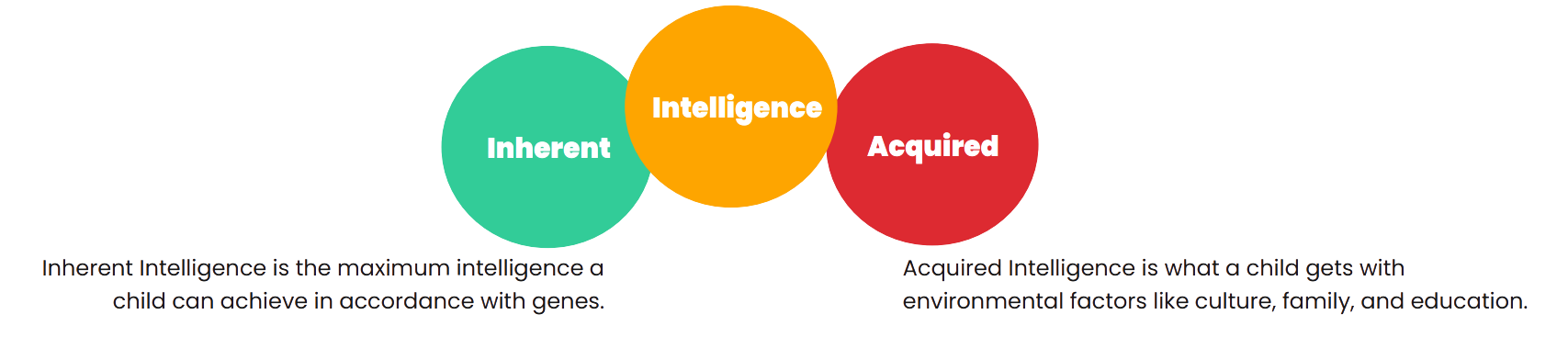
philosophy is inspired by environmental factors like
culture, family, and education. the Montessori method.
Each material has been designed following this philosophy.
The teachers have been trained effectively on the
philosophy, curriculum, and materials. Academically
equipped and socially adept children are what we are
striving to provide this world.
The Philosophy
A Child’s path to excellence begins with the perfect role
model and the perfect tools.
Research proves that Early Education is critical because:
-
Brain development is most rapid in the early years.
-
75% of neural connectivity is complete by the age of 7.
-
When the quality of stimulation is deficient, child
development is seriously affected.
The capacity to absorb concepts and learn is highest
during Ages 2 to 6. Hence it is important to expose the
child to an environment that provides an appropriate
stimulus for learning.
Intelligence is an important factor to consider when a
child comes to school.
The Curriculum
Our curriculum is focused on the following areas of
development:

A Curriculum is a set of experiences and events that are
planned to foster a child’s learning. Our curriculum
explores.
The Environment
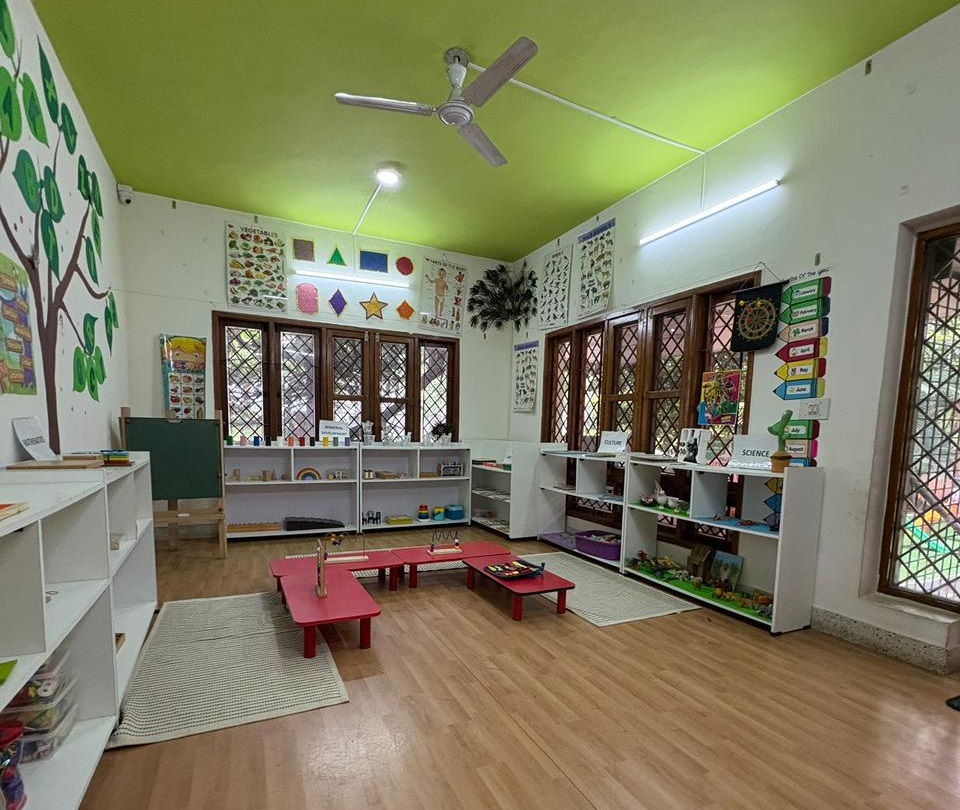
The environment is a major part of our curriculum. A young
child must get daily experience with learning aids in a
structured environment which has specific usage, derived
from the curriculum. The environment in our curriculum
facilitates self-learning in every child.
The Teachers
Our staff is trained to ensure that the curriculum
objectives for each child are met consistently. They are
trained to facilitate learning, observe, record, and
assess daily. We have an appropriate student-teacher ratio
to ensure that every child's needs are met so that they
don’t excessively depend on an adult.
Methodology
-
Teachers are facilitators
-
Self-Learning Environment
-
Each Child at his own pace
-
Self-correction
-
Inner discipline
-
Daily observation and assessment
-
Socially vibrant environment
-
Encouraging the child’s inherent desire to do and
learn.
Learning Modes
Our curriculum has activities that are specifically
designed to help a child in every Teachers are
facilitators area of development. These activities
include.
Research proves that Early Education is critical because:
- Individual learning with materials
-
Small group activities in art, language, and gross motor
skills
- Learning through a thematic approach
-
Occasional support learning through role-plays,
presentations, storytelling,
- Reading
- Field trips
- Project-based learning for older children
- Cultural celebrations
A child’s home environment plays an important role in
shaping a child’s personality. Our curriculum includes
parent feedback sessions and guidelines to ensure that the
school and home environment together foster the child’s
development.
Cognitive / Academic Learning
Every activity in the school is done with a clear-cut
objective and outcome for the child.
In the 2 to 4 years category, we begin with fine motor and
practical life skills. English is introduced with
phonetics. Mathematics is introduced with materials that
help the child comprehend this very abstract area. Other
activities help with cognitive development and logical
thinking.
In the 4 to 6 age group, children are taken through a
program that covers fairly complex areas of language,
mathematics, geography, history, and science in a manner
that will help them understand the fundamentals.
Critical Non-Academic Learning
The curriculum provides opportunities for children to make
decisions about their work. Children have the choice to
work in small groups/ individually depending on their
needs.
We encourage our children to receive help from and offer
help to other children, thus injecting a sense of social
awareness. Mixed-age grouping also helps them become
better learners.
Our curriculum helps them with practical skills like
cutting, sieving and gardening, and other areas of art.
Physical Development is an important part of childhood and
we take special care of this with structured activities.
Assessment
Assessment in the early years of a child has to be a
continuous process. Our system constantly checks on the
child's progress and helps teachers to keep up with the
progress and updates of the child hence they can step in
to make any necessary changes.





 About Us